
Covid-19 Superinfection may Emerging as a New Norm
a admin 1/16/2023
Preventing covid-19 virus at the moment, is also the high season of respiratory diseases such as influenza. Zhong Nanshan, a member of the Chinese Academy of Engineering, recently said that the cause of the recent fever is not simply an infection with covid-19 virus, but also influenza, and a few people may be doubly infected.
Previously, the Chinese Center for Disease Control and Prevention(CDC) had issued an early warning: this autumn and winter or winter and spring, there may be a risk of superimposed epidemics of influenza and covid-19 infections.
2022-2023 Influenza Season
May pose risk of influenza outbreak pandemic
Influenza is an acute respiratory infectious disease caused by influenza virus and is one of the major public health problems faced by humans.
Because influenza viruses are antigenically variable and spread rapidly, they can cause seasonal epidemics each year. According to World Health Organization (WHO) estimates, the annual seasonal epidemic of influenza can cause more than 600,000 deaths worldwide, equivalent to one death due to influenza every 48 seconds. And a global pandemic could even kill millions. Influenza can affect 5% -10% of adults and about 20% of children worldwide each year. This means that in the high influenza season, 1 in 10 adults is infected with influenza; 1 in 5 children is infected with influenza.
Covid-19 superinfection may emerging as a new norm
After three years, the new coronavirus continued to mutate. With the emergence of Omicron variants, the incubation period of new coronavirus infection was significantly shortened, the transmission intergenerational was accelerated, the transmission occult and transmission efficiency were significantly enhanced, combined with reinfection caused by immune escape, which made Omicron variants have significant transmission advantages compared with other variants. In this context, it coincides with the high incidence of influenza in midwinter, and while we have to face up to the disease hazards and epidemic status of influenza in the current season, we should consider whether we are currently facing the risk of superinfection with new coronavirus and influenza.
1.the global wide range of "Covid-19 + influenza" double epidemics is obvious
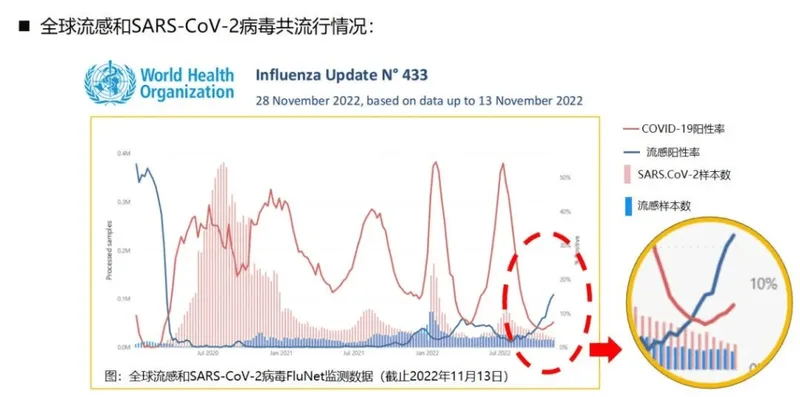
From WHO surveillance data, it can be seen that as of November 13, 2022, the epidemic of influenza virus has increased significantly this winter, and the trend of superimposed epidemic of covid-19 influenza is very obvious.
We should realize that, quite different from the characteristics of "it is difficult to determine whether there is a superposition of the two viruses of covid-19 and influenza in the early stage of covid-19, and it is not excluded that covid-19 positive patients have influenza", there is currently a situation of "double epidemic" of covid-19 and influenza on a large scale worldwide. Especially since entering this winter, fever clinics in many places in China have been full, indicating that the current status of viral infection is completely different from that three years ago, while the number of patients with "influenza-like symptoms" remains high, which is also closely related to the infection coefficient of Omicron variants. The cause of fever in infected people is no longer simply a covid-19 infection, many patients are infected with influenza, and a few may have double infection.
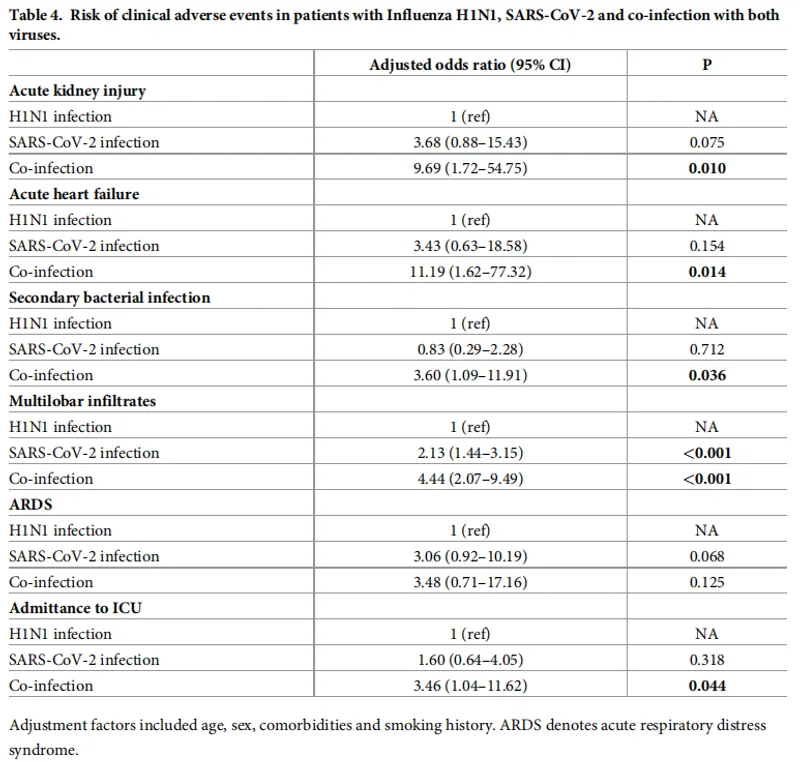
- Influenza virus infection significantly promotes Covid-19 virus invasion and replication
▲ Risk of clinical adverse events in patients with influenza A H1N1, SARS-CoV-2 and co-infection with these two viruses
Transformation of therapeutic ideas: Treatment of single Covid-19 infection shifts to comprehensive and symptomatic treatment as key With further liberalization of epidemic control, Covid-19 co-infection with influenza has become a more difficult problem. According to Professor Liu Huiguo of the Department of Respiratory and Critical Care Medicine, Tongji Hospital, Huazhong University of Science and Technology, Covid-19 virus and influenza virus may theoretically be co-infected, and at the current stage, their co-presence is about 1-10%. However, we cannot deny that as more and more patients are infected with the Covid-19 Omicron variant strain, people's immune barrier will become higher and higher, so the percentage of influenza infection will then increase slightly in the future, and a new norm will then be formed. However, these are not the issues that need to be focused on at the moment, but rather on whether Covid-19 infection will increase the chance of influenza infection, and therefore the diagnosis and treatment need to be treated objectively in the context of clinical practice. Which groups of people need to be on high alert for superimposed infections of Covid-19 and influenza? For example, people with underlying diseases, the elderly and frail people, whether they are infected with Covid-19 or influenza alone or in combination with the two viruses, can be life-threatening, and these people still need our close attention. With the recent surge of Covid-19-positive patients, how can we do a good job of "promoting prevention, diagnosis, control and treatment of health" in the context of Covid-19, which is currently dominated by Omicron variant strains? First of all, the diagnosis and treatment should gradually change from the treatment of single Covid-19 infection to comprehensive treatment and symptomatic treatment. Early diagnosis and treatment to reduce complications, lower hospitalization rate and shorten the course of illness are the keys to improve the clinical cure rate and reduce the death rate. When influenza infection forms a new normal, attention to influenza-like cases is the key to achieve early diagnosis. At present, in terms of prevention, it is recommended that we insist on wearing masks to prevent the rapid spread of the virus, firstly, because patients who have been infected with Covid-19 in the early stage and have now turned negative cannot exclude the possibility of repeated infection; secondly, because in addition to Covid-19 infection, they may also be co-infected with other viruses (such as influenza) and may carry the virus in their bodies even after they have turned negative and recovered.